Efficient funeral home workflows are the foundation of calm, compassionate service. When your processes are clear and consistent, your team can focus on caring for families instead of chasing paperwork, correcting errors, or struggling with miscommunication. By systematically examining how your team works, you can identify bottlenecks and implement changes that reduce stress and improve the quality of your care.
Improving your funeral home's operational flow isn't about cutting corners; it's about creating more time and mental space for the human side of your work. These seven strategies provide a practical framework for analyzing, standardizing, and optimizing your daily operations, from the first call to long after the service has ended.
1. Map Your Existing Workflows from First Call to Final Disposition
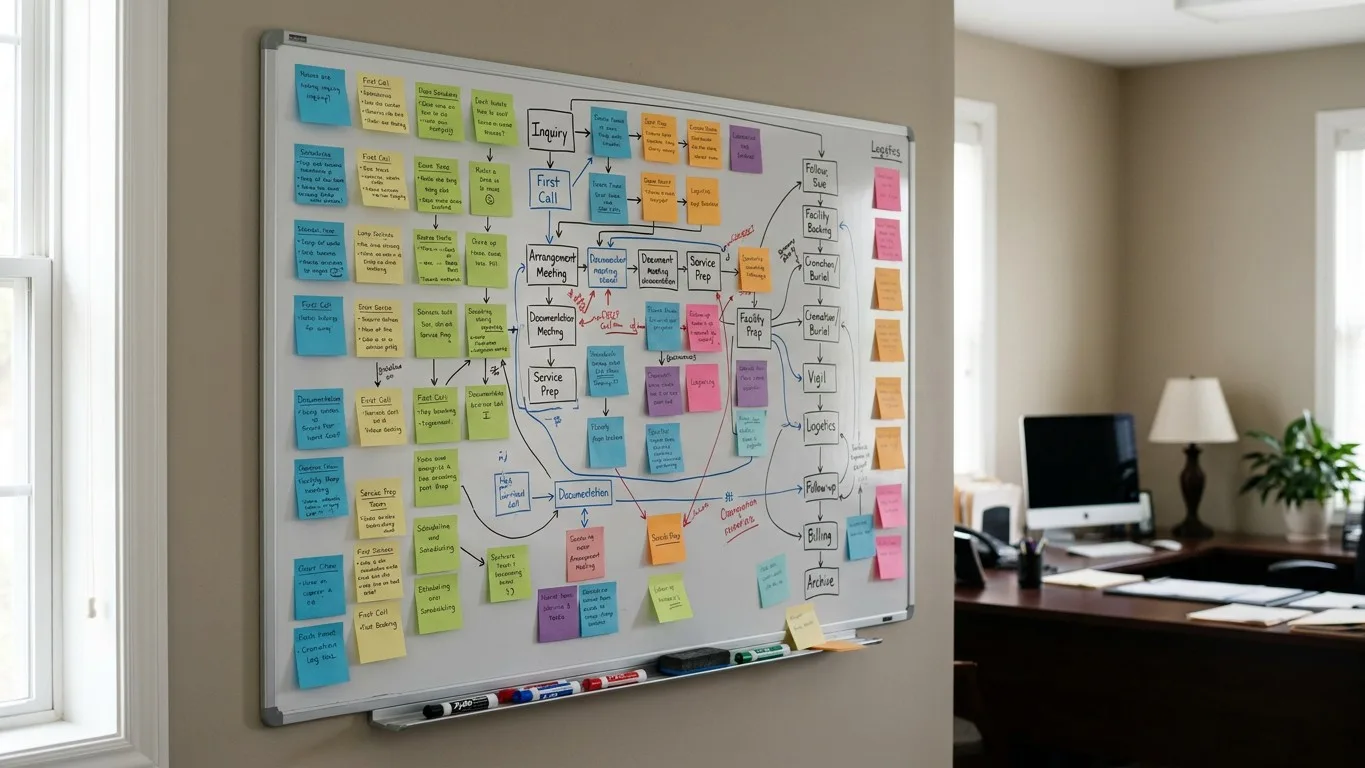
Before you can improve your processes, you must understand them in detail. Mapping your funeral home workflows makes the invisible visible, revealing each step, handoff, and potential point of friction. This exercise isn't about judgment; it's a diagnostic tool to see how work actually gets done, which is often different from how you think it gets done.
Gather your team—directors, arrangers, administrative staff, and apprentices—with a large whiteboard or a wall and a stack of sticky notes. Trace a single case through its entire lifecycle, documenting every action.
- First Call and Transfer: Who takes the call? What information is collected? Who is dispatched for the transfer? How is the decedent's information recorded and passed to the arrangement team? Note every tool used, from a paper form to a text message.
- Arrangement Conference: Who meets with the family? What documents are prepared beforehand? How are decisions about the service, merchandise, and disposition captured? Where do handwritten notes go after the meeting?
- Pre-Service Preparation: How are tasks assigned for drafting the obituary, ordering flowers, coordinating with the cemetery, and preparing the deceased? Follow the path of a death certificate, from gathering vital statistics to filing with the registrar.
- The Service: Who coordinates the staff, vehicles, and clergy on the day of the service? How are last-minute changes communicated? Who is responsible for managing the procession or setting up the chapel?
- Post-Service Tasks: Who handles the final billing and accounting? How are thank-you cards, memorial items, and death certificates delivered to the family? What is the process for closing out the case file?
As you build this map, ask critical questions at each stage. Where do people have to wait for information? Where does the same detail get entered into multiple systems? Which steps cause the most frustration or lead to the most errors? This visual map becomes your blueprint for targeted improvements.
2. Standardize and Document Key Processes
Once you have a map of your current workflows, the next step is to standardize them. Standardization ensures that every family receives the same high level of care and that every team member understands their role, regardless of who is on duty. It reduces ambiguity, minimizes mistakes, and makes training new staff more effective.

Start by creating documented procedures for high-stakes, repeatable tasks. These aren't meant to be rigid scripts that stifle professional judgment, but rather a consistent foundation to build upon. Your goal is to create a shared playbook that codifies your funeral home's best practices.
Create Comprehensive Checklists
Checklists are one of the most powerful tools for ensuring accuracy. Develop detailed checklists for each major phase of the workflow you mapped. For example, a complete funeral director checklist might include separate sections for the first call, the arrangement conference, and post-service follow-up. Other examples include:
- Vehicle Preparation Checklist: Stocking the transfer vehicle with necessary supplies.
- Chapel Setup Checklist: Ensuring flowers, memorial boards, and AV equipment are ready.
- Cremation Paperwork Checklist: Verifying all authorizations and permits are signed and filed before proceeding.
Develop Standard Operating Procedures (SOPs)
For more complex processes, a simple checklist may not be enough. An SOP is a short document that explains the who, what, when, and why of a specific task. Good candidates for SOPs include handling a first call from a hospital versus a residence, coordinating with a specific cemetery, or processing veteran burial benefits. An SOP provides clarity and ensures that even infrequent tasks are performed correctly.
Use Templates for Forms and Communications
Create standardized templates for all your essential documents and family communications. This includes the General Price List, statement of goods and services, cremation authorizations, and email correspondence. Templates ensure that all necessary legal language is included and that your branding remains consistent. Using templates also saves significant time, freeing staff from having to write the same information repeatedly.
3. Centralize Information to Eliminate Duplicate Data Entry
One of the biggest drains on efficiency in any funeral home is scattered information. When case details live on sticky notes, in various spreadsheets, on a whiteboard, and in a director's notebook, your team spends valuable time just looking for the right information. Worse, this fragmentation inevitably leads to duplicate data entry, which is the primary source of costly and distressing administrative errors.
Every time a staff member re-types a name, date, or detail, there is a risk of introducing a typo. An error in an obituary, on a death certificate, or in a contract can cause significant distress for a family and damage your firm's reputation. The solution is to establish a single source of truth for every case.
Modern funeral home management software is designed to solve this problem. By using a centralized digital case management system, you enter information once. From the moment the first call details are recorded, that data flows seamlessly throughout the entire system. The decedent's name, dates, and family contact information can automatically populate contracts, state-specific forms, obituaries, and memorial printing orders. This not only saves hundreds of hours of administrative work but also dramatically reduces the chance of error. A well-designed system ensures that everyone on your team is working from the same, most up-to-date information, whether they are in the arrangement room, at the front desk, or on the road.
4. Implement Clear Communication and Handoff Protocols
In a busy funeral home managing multiple cases, clear communication isn't just helpful—it's essential. Ambiguous instructions and poor handoffs between team members lead to missed tasks, confusion, and a stressful work environment. A family should never feel the friction of your internal operations. Creating formal communication protocols ensures smooth transitions and a cohesive team effort.
Start with a daily team huddle. A brief, 10-to-15-minute meeting each morning can align the entire staff. Review the day's services, transfers, and arrangement conferences. Discuss any special family needs or potential challenges. This simple routine ensures everyone knows the day's priorities and can anticipate where help might be needed.
Next, define your handoff procedures. For example, when the on-call director who handled a transfer hands the case over to the funeral arranger, what is the exact process? Create a simple protocol. The on-call director should enter all first call notes and initial case details into your central management system. They can then assign the case to the arranger and add a note confirming the handoff is complete. This creates a clear, documented transfer of responsibility, so nothing falls through the cracks.
Use your central system as the primary communication hub for case-specific information. Instead of relying on hallway conversations or text messages, encourage staff to add notes directly to the digital case file. This creates a permanent record that any authorized team member can access. If a family calls with a question, anyone at the front desk can look up the case and provide an accurate answer, even if the primary director is unavailable.
5. Optimize Scheduling for Staff, Services, and Fleet
Funeral home scheduling is a complex puzzle with three constantly moving layers: staff availability, service logistics, and vehicle fleet coordination. Relying on a physical whiteboard or a basic shared calendar can quickly become chaotic, leading to double-bookings, understaffed services, or a hearse being in the wrong place at the wrong time. These scheduling mishaps are not only inefficient but also create immense stress for your team and can disrupt a family's service.
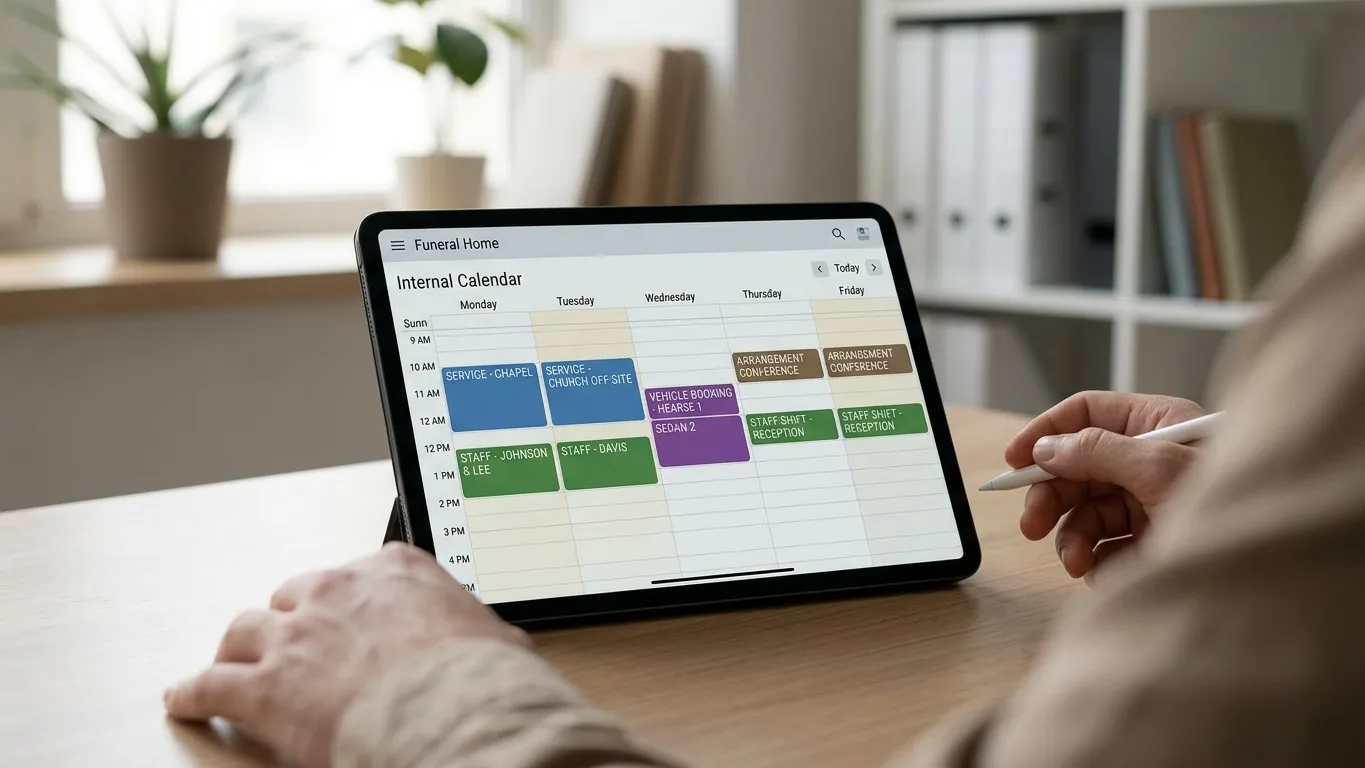
A modern approach to funeral home workflows involves a centralized, digital scheduling system. The ideal tool provides a single view of all scheduled events, staff assignments, and vehicle usage across all your locations. When you book a service in the chapel, that time slot should immediately become unavailable. When you assign a director, two pallbearers, and a hearse to that service, they should be visibly allocated for that duration.
This integrated approach prevents conflicts before they happen. A manager can see at a glance who is available for a last-minute transfer or if there is a vehicle free for a flower run. Staff can check their schedules from any device, reducing the need for constant phone calls to the office to confirm their assignments. By moving away from manual methods, you create a more organized and predictable environment. This allows you to deploy your resources—both people and vehicles—more effectively, ensuring every service is staffed appropriately and runs smoothly.
6. Adopt Technology to Automate Repetitive Administrative Work
Much of a funeral director's time is spent on necessary but repetitive administrative tasks: transcribing notes, filling out forms, writing obituaries, and creating memorial materials. While essential, this work can consume hours that would be better spent with families. Adopting modern funeral home technology can automate many of these tasks, freeing your team to focus on more meaningful work.
Consider the arrangement conference. Instead of furiously taking handwritten notes while trying to remain present with a grieving family, technology can help. For instance, Kindred's built-in AI tools can listen to a recorded arrangement meeting and generate a detailed summary, a list of decisions made, and action items. The director can then review and edit these AI-generated notes, saving significant time while ensuring every detail is captured accurately. The system can even read a photo of handwritten notes and suggest fields to populate in the case file.
This automation extends to other areas as well. Once case information is entered, it can be used to automatically generate a first draft of an obituary, which the family can then personalize. The same data can flow into a media designer tool to create memorial cards, service programs, and bookmarks in minutes, not hours. Designs can be sent to the family for approval through a secure portal before printing. These tools don't replace the director's role; they support it by handling the time-consuming administrative burdens that often lead to late nights at the office.
7. Create a Culture of Continuous Improvement
Optimizing your funeral home workflows is not a one-time project; it's an ongoing commitment to getting better. The needs of families change, regulations evolve, and new technologies become available. The most efficient and successful funeral homes build a culture where every team member feels empowered to identify problems and suggest improvements.
Make workflow discussions a regular part of your team meetings. Once a quarter, revisit the workflow maps you created. Ask the team: What's working well? Where are we still getting stuck? Are our checklists and SOPs still relevant, or do they need updating? This creates a safe space for constructive feedback. An apprentice might notice a recurring issue with supply orders that a senior director overlooks, and their suggestion could save the firm time and money.
Celebrate small wins. When a team member proposes a change that eliminates a redundant step or prevents a common error, acknowledge their contribution publicly. This reinforces the idea that everyone's perspective is valuable. You can also learn from mistakes. When something goes wrong—a piece of information is missed or a schedule gets mixed up—conduct a brief, blameless post-mortem. The goal isn't to assign fault but to understand the root cause of the problem and adjust the process to prevent it from happening again. By embracing this mindset, your funeral home becomes a learning organization, constantly refining its operations to better serve families and support its staff.
Better Workflows Mean Better Care
Building more efficient funeral home workflows is a direct investment in the quality of your service and the well-being of your team. By mapping your processes, standardizing procedures, centralizing information, and adopting supportive technology, you eliminate the friction and administrative drag that cause stress and errors. The result is a calmer, more organized operation where your staff has the time and energy to provide the compassionate, detailed care every family deserves.
Kindred was built by funeral directors to solve these exact challenges. Our platform centralizes every aspect of a case, from first call and scheduling to forms and accounting, creating a single source of truth that powers a more efficient workflow. To see how Kindred can help your team work more calmly and effectively, book a demo with our team.