Choosing the right funeral home management software can feel overwhelming, but the core purpose is simple: to reduce administrative burdens so you can focus on serving families. The best systems provide a central, reliable place for every piece of information, from the first call to the final invoice. This guide walks through the essential funeral home management software features your firm needs to operate with precision, compassion, and efficiency.
Centralized Case Management: The Single Source of Truth
The foundation of any funeral home software is its ability to manage cases. A robust case management module acts as the digital file for each decedent, ensuring that every piece of information is accurate, accessible, and secure. This isn't just about storing data; it's about creating a single source of truth that your entire team can rely on, eliminating the risks associated with paper files, spreadsheets, and scattered information.
From the moment a first call is logged, the system should begin building the case file. This includes vital statistics, contact information for next of kin, and initial service preferences. As the case progresses, this file expands to include every detail: arrangement notes, merchandise selections, service schedules, and staff assignments. A well-designed system makes this information visible to authorized staff, providing a real-time overview of every active case. This visibility is crucial for coordinating tasks and providing families with consistent, accurate answers.
Effective case management also incorporates detailed checklists. Funeral service is a profession of details, and a missed step can cause significant distress for a family. Digital checklists, customized to your firm’s specific workflows for different types of services (such as burial, cremation, or veteran services), ensure that no task is overlooked. When a director can see at a glance that the death certificate has been filed, the obituary submitted, and the celebrant confirmed, it instills confidence and reduces mental overhead.
For firms with multiple locations, centralized case management is non-negotiable. The ability for a director at one branch to access case information for a service happening at another, or for an owner to view the status of all cases across the entire organization, is essential for modern operations. This requires role-based access controls, ensuring that staff members only see the information relevant to their duties, protecting both family privacy and business operations.
Contracts, Forms, and E-Signatures
Paperwork is an unavoidable reality in funeral service, but the way it's managed can make a significant difference in your firm's efficiency and accuracy. One of the most critical funeral home management software features is the ability to generate contracts, authorizations, and other essential documents directly from case data. This single-entry system is the most effective way to eliminate the hidden costs of duplicate data entry.

Think of the traditional process: a director writes down information during an arrangement conference, then an administrator re-types that same information into a statement of goods and services, a death certificate worksheet, an authorization form, and an obituary notice. Each time the data is re-entered, the risk of a typo or transposition error increases. A misspelled name or an incorrect date on a legal document can create serious problems for both the family and the funeral home. Software prevents this by populating all necessary forms from the single, authoritative case file.
Furthermore, regulations and required forms vary by state and even by county. Your software must be flexible enough to accommodate these local requirements. A quality system will allow for the creation of custom forms specific to your funeral home's operations, alongside standard, state-mandated documents. When your software is configured to your exact needs, it becomes an extension of your professional standards, ensuring every document your firm produces is consistent, professional, and accurate.
In recent years, electronic signatures have become an essential feature. The ability for a family to review and sign contracts and authorizations remotely is no longer a luxury; it's a matter of practical service. It saves families a trip to the funeral home during an already stressful time and streamlines the administrative process for your team. Instead of waiting for a family member to print, sign, scan, and email a document, the process can be completed in minutes through a secure digital portal, allowing your team to move forward with arrangements promptly and with full legal authorization.
Integrated Funeral Home Accounting
Funeral home accounting is unique. It’s not like standard retail or small business accounting; it involves trust funds, insurance assignments, pre-need conversions, and complex sales contracts. A generic accounting program like QuickBooks, while powerful, often requires awkward workarounds to manage the specific financial workflows of a funeral home. That's why one of the most important funeral home management software features is an integrated accounting module designed specifically for death care.
When your accounting system is part of your case management platform, the Statement of Funeral Goods and Services is not a separate document but a direct output of the case file. As you add merchandise, cash advance items, and services to a case, the contract and ledger are updated automatically. This eliminates manual reconciliation and ensures that what the family agreed to is exactly what they are billed for. Payments, whether from the family, an insurance policy, or a trust, can be applied directly to the case ledger, providing a clear, real-time financial picture of every case.
This integration provides powerful reporting capabilities. A funeral home owner should be able to see, at a glance, the firm's accounts receivable, average revenue per call, and merchandise sales trends without having to manually compile data from different systems. This financial clarity is essential for making informed business decisions, managing cash flow, and identifying opportunities for growth. For example, by analyzing sales data directly from your management system, you might notice a trend in casket or urn selections that informs your inventory purchasing.
While built-in accounting is crucial, the ability to connect with external accounting software is also important. Many funeral homes have established relationships with bookkeepers or accountants who prefer to work in QuickBooks or Sage 50. Therefore, a modern system should offer the best of both worlds: robust, built-in funeral-specific accounting, with the option to sync with QuickBooks Online or export data for QuickBooks Desktop. This flexibility allows you to run your daily operations within the funeral home software while still accommodating your external financial professionals' needs.
Family-Facing Tools and Communication
Modern funeral service isn't just about what happens inside the arrangement room; it's also about the experience you provide to families online. Today, families expect a level of digital convenience in every aspect of their lives, and interacting with a funeral home is no exception. That's why essential software features now include tools that directly serve and communicate with the family.
A secure, branded family portal is a prime example. This feature gives families a private online space where they can collaborate on obituary information, complete necessary forms, view arrangement details, and see a running total of expenses. This empowers families by giving them access to information whenever they need it, reducing the number of phone calls to the office to ask for a copy of a document or confirm a service time. It also allows for efficient collaboration among family members who may be spread across different cities or even countries.
Integrated website and obituary publishing is another critical component. Your funeral home's website is its digital front door. When your management software is connected to your website, obituaries can be published directly from the case file with a few clicks. This eliminates the need to copy and paste information, reducing the chance of errors. Families can then easily share the online obituary through social media, and guests can find service details, leave condolences, and, if enabled, order flowers or make memorial donations directly through the site.
Kindred, for example, connects case management directly to a secure family portal and integrated funeral home websites. When a director enters obituary text and service times into a case, that information can be published to the website automatically, ensuring accuracy. Families can be given access to the portal to upload photos, fill out biographical information, and review documents at their own pace. These tools don't replace the personal care of a funeral director; they enhance it by making the administrative aspects of arranging a funeral smoother and more transparent for the family.
Practical AI and Workflow Automation
The conversation around artificial intelligence in funeral service is often met with skepticism, and for good reason. The work of a funeral director is deeply human and cannot be automated. However, the administrative tasks that surround that work are often repetitive and time-consuming. Practical AI tools are an emerging feature in modern funeral home software, designed not to replace directors, but to act as a capable assistant, freeing them up to spend more time with families.
One of the most promising applications is in the arrangement conference itself. Imagine being able to focus completely on the family's conversation without having to split your attention to take detailed notes. Some systems now offer AI tools that can listen to a recording of an arrangement meeting (with the family's permission, of course) and produce a detailed transcript. From that transcript, the AI can generate a summary of the conversation, a list of decisions made, and a list of action items for the director. The director remains in full control, reviewing and editing the AI's output before accepting it into the case file.
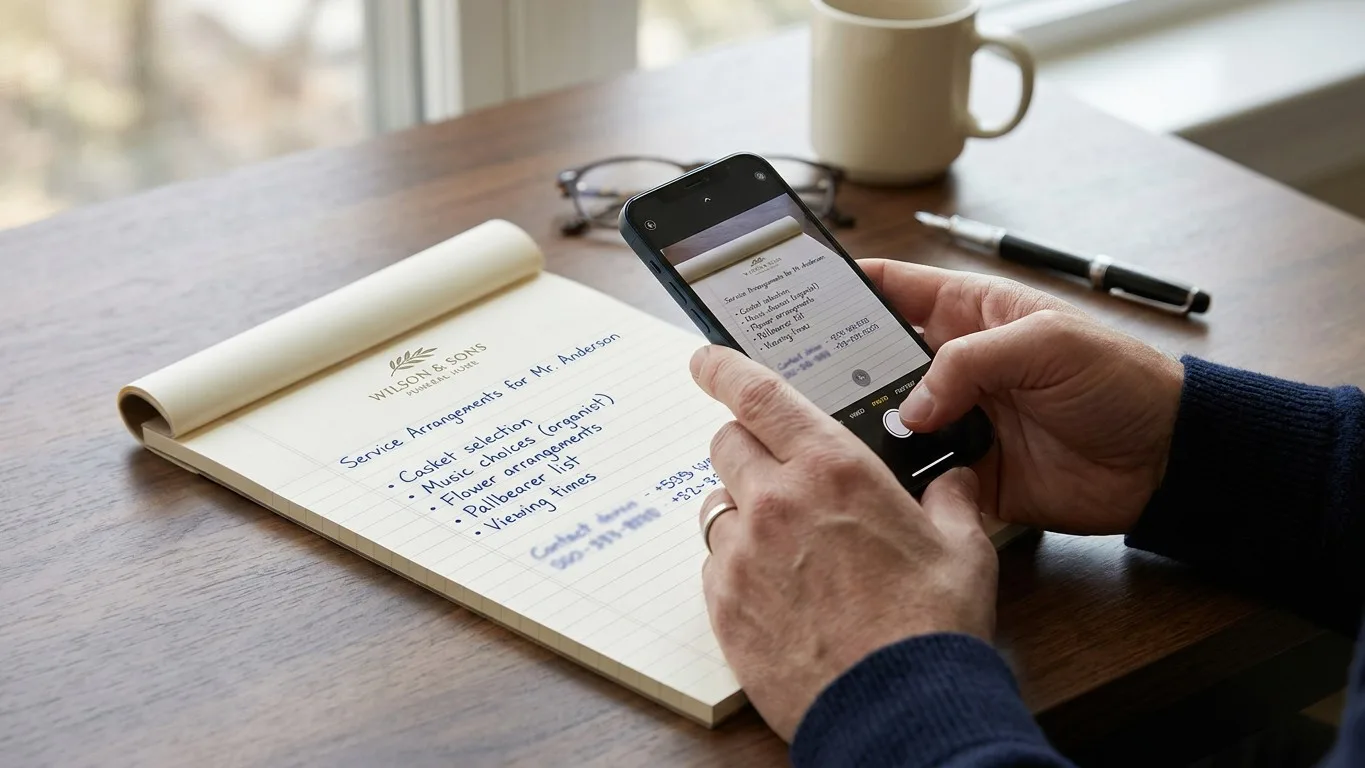
Another practical use is data capture. Many directors still prefer to take handwritten notes during an arrangement. Instead of requiring an administrator to manually type those notes into the system later, a director can simply take a photo of the notes with their phone. AI tools can then analyze the handwriting and suggest the corresponding fields in the case file to populate, such as the decedent's name, date of birth, or selected merchandise. Again, the director reviews and confirms every piece of data before it is saved, ensuring 100% accuracy while saving significant data entry time.
These automations extend beyond AI. Workflow automation can handle routine tasks like sending a follow-up email to a family after the service or creating a task for the office manager to order a death certificate. By building these small, repeatable steps into the software, you create a system that helps streamline your funeral home's operations, ensuring consistency and allowing your staff to focus on the more complex, human aspects of their work.
Security and Accessibility
Funeral home records contain some of the most sensitive personal information a business can handle. Protecting this data is not just a matter of good practice; it's a fundamental responsibility. Therefore, robust security features are an absolute requirement for any funeral home management software you consider. This includes encryption of data both in transit (as it moves between your computer and the server) and at rest (while it is stored in the database). Your software vendor should be able to clearly articulate their security practices.
Security also involves access control. Not every employee needs to see every piece of information for every case. Modern software should allow for role-based permissions, meaning you can define what different types of users can see and do. For example, an apprentice or a part-time removal technician may only need to see basic case information and their assigned tasks, while a funeral director needs full access to arrangement details, and an owner needs to see financial reports. These controls are essential for protecting family privacy and preventing accidental changes to sensitive data.
Finally, the software must be accessible to your team wherever they are working. The days of software being tied to a single server in the back office are fading. Cloud-based software allows your staff to securely access case information from any computer with an internet connection, whether they are in the arrangement room, at a satellite location, or on the road. This accessibility is crucial for providing responsive service. If a family calls a director on their cell phone with a question after hours, the director can log in and provide an accurate answer immediately, rather than having to say, “I’ll check when I get back to the office.” This level of responsiveness demonstrates a high level of care and professionalism.
Choosing the Right System for Your Firm
The essential features of funeral home management software all point to a single goal: creating a more organized, efficient, and compassionate operation. By centralizing case management, automating paperwork, integrating accounting, and providing modern tools for family communication, the right software gives your team the structure they need to do their best work.
When evaluating your options, look beyond a simple list of features. Ask how the software will fit into your specific workflows. Consider the quality of the implementation process and the ongoing support you will receive. The best system is one that feels like a partner in your service to families, built by people who understand the unique demands of this profession.
Kindred was designed by funeral directors to solve these exact challenges. If you're ready to see how a modern, cloud-based system can support your team and enhance the service you provide to families, we invite you to book a personalized demo.