
Managing multiple funeral services at once is one of the most demanding challenges in funeral service. When your firm is busy, the logistical complexity grows exponentially, increasing the risk of errors that can cause deep distress to families. Excelling during these periods requires a systematic approach that combines meticulous organization, clear communication, and unwavering compassion for each family you serve.
Successfully navigating a packed schedule isn't about rushing; it's about having robust systems that allow you and your team to focus on the human element of your work. This guide provides practical strategies for funeral directors to manage concurrent cases with precision and care, ensuring every family feels like they are your only priority.
The Foundation: Centralized Information and Communication
When you are handling several cases simultaneously, scattered information is your greatest vulnerability. A detail written on a sticky note, a verbal instruction passed between staff in the hallway, or a schedule updated on a physical whiteboard can easily get lost. The key to managing a high-volume workload is establishing a single, reliable source of truth that your entire team can access.
This central hub should contain every piece of information for every active case, from first call details to post-service follow-ups. When information is fragmented across different systems—paper files here, a calendar there, accounting software somewhere else—the risk of mistakes multiplies. A staff member might prepare a vehicle for the wrong cemetery, use an outdated version of a contract, or misplace a crucial document. These errors, born from disorganized data, undermine a family's confidence at the worst possible time.
Adopting a system where information is entered once and then populates everywhere it's needed is the most effective way to prevent these issues. This approach is fundamental to creating consistent, accurate documentation and workflows. For example, when the decedent's name is entered correctly at the first call, it should automatically appear on the contract, the death certificate worksheet, the obituary, and all internal checklists. This eliminates the tedious and error-prone task of retyping the same details over and over.
Effective communication flows from this central information source. Instead of relying on memory or word-of-mouth, team members should be able to see the current status of any case at a glance. Is the death certificate filed? Has the family approved the obituary draft? Is the cremation permit ready? When this information is visible to everyone who needs it, handoffs become smoother and accountability becomes clearer. This transparency reduces the need for constant check-in meetings and interruptions, freeing up directors to spend more time with families.
Mastering the Arrangement Conference for Multiple Families
The arrangement conference is the heart of your service to a family. When you have back-to-back arrangements scheduled, the challenge is to be fully present for each family, giving them your complete and undivided attention. This requires mental discipline and a structured process to ensure you capture every detail accurately without feeling rushed.

Preparing for Each Arrangement
Preparation is non-negotiable. Before a family arrives, take at least 15 minutes to review their case file. Re-read the first call notes, understand the family dynamics you're aware of, and confirm the decedent's details. This simple act of preparation grounds you in their specific loss and prevents the dangerous mental overlap that can occur when juggling multiple cases. It also allows you to anticipate questions they might have, such as those related to veteran burial benefits or specific religious customs.
Creating a Mental Reset
Between arrangement conferences, create a brief ritual to mentally close one case before opening the next. This could be as simple as standing up, stretching, getting a glass of water, and tidying the arrangement room. Spend a few moments organizing your notes from the previous meeting and filing them correctly. This physical act of closing one chapter helps your mind transition, ensuring you greet the next family with a fresh perspective, free from the emotional and logistical residue of the last arrangement.
Structuring the Conversation with Checklists
A standardized agenda or checklist is your best tool for ensuring consistency and completeness during the arrangement. This isn't about being robotic; it's about creating a framework that frees you to listen actively. By relying on a checklist, you don't have to expend mental energy remembering every single item that needs to be discussed, from vital statistics and service times to merchandise selections and obituary details. This structure ensures no critical detail is missed, even on your busiest day. Using a digital checklist within your case management system allows you to mark items as complete in real time, providing a clear record of what was decided.
Capturing Information Accurately
Taking detailed, organized notes is essential. Whether you use a legal pad, a laptop, or a tablet, your system should be consistent. If you are using handwritten notes, it's wise to transcribe them into the digital case file immediately following the conference to prevent misinterpretation later. Some funeral homes are turning to AI-powered tools that can transcribe spoken conversations, allowing the director to focus entirely on the family. Kindred’s AI Capture, for example, can transcribe handwritten notes or arrangement meeting audio, turning it into a structured summary and automatically populating case details. This reduces administrative work and ensures that the family's wishes are captured precisely as they were stated.
Coordinating Staff and Resources Across Services
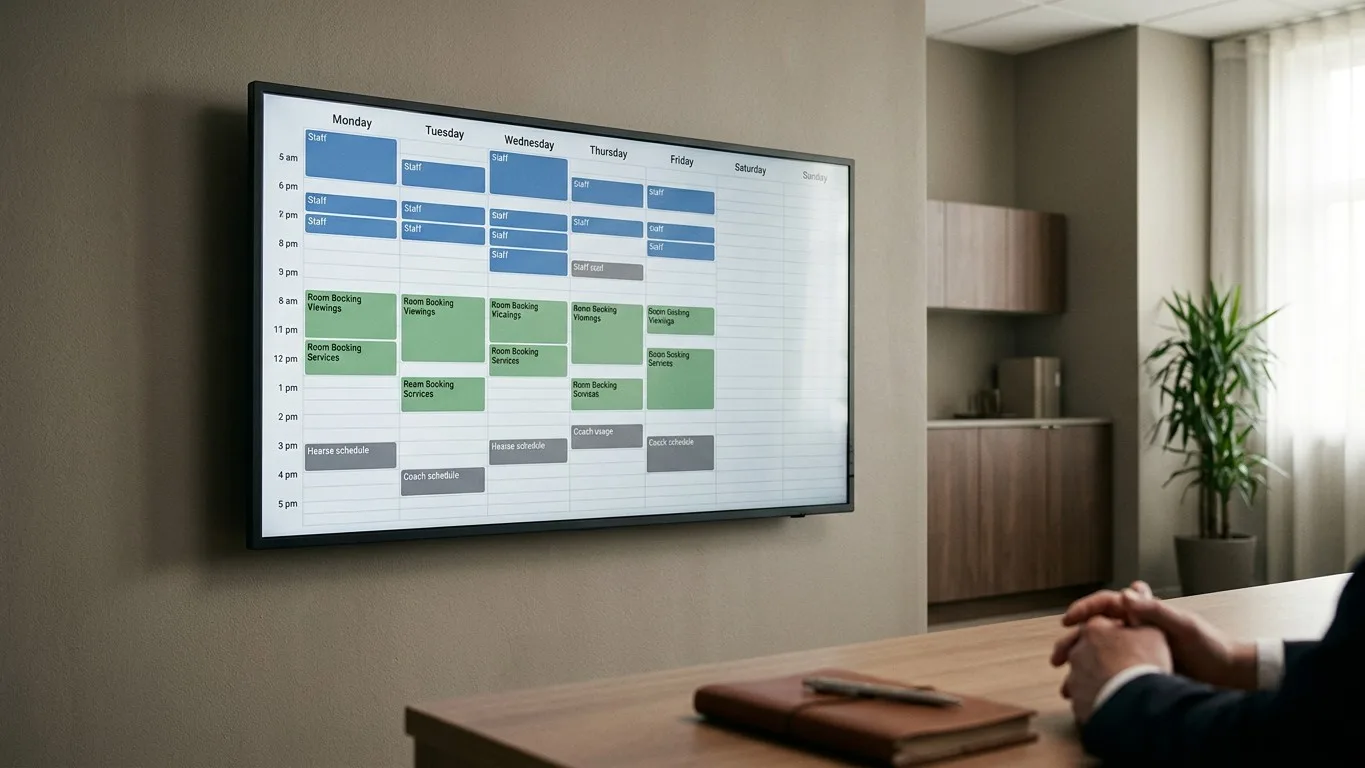
When multiple services are happening in close succession, the logistical coordination of staff, vehicles, and physical spaces becomes a complex ballet. A single scheduling error can create a domino effect, causing delays and immense stress for both your team and the families you are serving. A centralized, visible scheduling system is the only way to manage this complexity effectively.
Staff Scheduling and Assignments
Relying on a whiteboard or a paper calendar for staff scheduling is a recipe for confusion. These manual systems make it difficult to see who is assigned to which service, who is on call for removals, and who is available to assist with a visitation. A modern, centralized scheduling system provides a single, authoritative view of all staff assignments.
For each service, you should clearly assign roles:
- Lead Director: The primary point of contact for the family and the person ultimately responsible for the service.
- Support Staff/Attendants: Responsible for greeting guests, handing out programs, managing parking, and assisting the lead director.
- Removal Team: On-call staff for first calls that may come in during a service.
- Office Staff: Available to answer phones and handle administrative tasks that arise.
By defining these roles for every event, you eliminate ambiguity and ensure all responsibilities are covered. A digital calendar allows you to see at a glance if you have staffing conflicts or if a particular team member is over-scheduled.
Fleet and Vehicle Management
Managing your fleet of hearses, flower vans, and lead cars requires precise scheduling. Double-booking a hearse is not an option. Your central schedule must include vehicle assignments for every transfer, service, and procession. Each entry should specify the vehicle, the driver, the departure time, the destination, and the estimated return time. This level of detail is crucial for planning. For example, if a hearse is scheduled for a 10:00 AM graveside service at a cemetery an hour away, you know it won't be available for an 11:00 AM service at your chapel. This visibility prevents logistical nightmares and ensures your vehicles are always clean, fueled, and ready for their next assignment.
Room and Chapel Booking
Your funeral home's physical spaces are finite resources. When managing multiple services, you must carefully schedule your visitation rooms, chapels, and arrangement offices. Your central calendar should block out time for each event, including setup and cleanup. If a visitation for one family ends at 8:00 PM, you cannot schedule another family's visitation to begin in the same room at 8:00 PM. You must account for the time your staff needs to clean the room, reset flowers, and prepare for the next family. Booking rooms with these buffers prevents families from feeling rushed and ensures your facility is always presented in the best possible light.
Managing Concurrent Visitations and Services
The day of the service is when all your planning is put to the test. When visitations or services for different families overlap, your team must operate with heightened awareness and sensitivity. The goal is to create an environment where each family feels their service is the only one happening.
Clear Signage and Wayfinding
Clear, professional signage is essential. From the moment guests arrive in your parking lot, they should be guided to the correct entrance and room. Use digital display boards or elegant, printed signs in the lobby to direct guests to the appropriate service (e.g., "The family of John Smith" with an arrow pointing to the correct chapel or stateroom). This simple step prevents confusion and stops guests from accidentally walking into the wrong visitation, which can be deeply unsettling for everyone involved.
Staggering Start and End Times
Whenever possible, stagger the start times of concurrent services by at least 30 to 60 minutes. This helps manage the flow of traffic in your parking lot and lobby. If two large services begin at the same time, the entrance can become congested, creating a stressful first impression. Similarly, staggering end times prevents two processions from trying to leave your facility simultaneously. This requires proactive planning during the arrangement conference, where you guide families toward service times that work for them while also allowing your team to manage the logistics smoothly.
Briefing Your Team Before Each Event
Before the doors open for any visitation or service, hold a brief huddle with all assigned staff. This meeting, even if it's just five minutes long, is critical. Review the timeline, confirm staff roles, and discuss any specific family requests or dynamics. For example, you might remind attendants that the family has requested no photos or that a particular relative may need extra assistance. This ensures your entire team is aligned and prepared to provide seamless, attentive service.
Maintaining Separation and Privacy
The physical layout of your funeral home plays a big role in managing concurrent services. If possible, use separate entrances or wings of the building for different families. If you only have one main lobby, your staff must act as gracious hosts, guiding guests to the correct location. The most important principle is to maintain the sanctity of each family's space. Staff should never discuss details of one family's service in the presence of another. Each family deserves to feel that their grief and their final farewell are honored in a private, dignified setting.
The Post-Service Workflow for Multiple Cases
The work of a funeral director doesn't end when the service concludes. The post-service administrative tasks are just as critical, and when you are juggling multiple cases, this is another area where details can be missed. A systematic post-arrangement workflow ensures that every case is closed out completely and accurately.
Using a Post-Service Checklist
Just as a checklist is vital for the arrangement conference, a post-service checklist is essential for ensuring all follow-up tasks are completed. This checklist should be a standard part of every case file. Key items on this checklist should include:
- Filing the original death certificate and ordering certified copies.
- Submitting claims for life insurance policies or veteran benefits.
- Sending thank you notes to clergy, musicians, and pallbearers.
- Ensuring all merchandise has been delivered and all financial accounts are settled.
- Following up with the family to see if they need additional support or grief resources.
By working through a standardized checklist for each case, you can be confident that no loose ends are left untracked. This process is especially important when one director handles the arrangement but another oversees the follow-up; the checklist serves as a clear communication tool between team members.
Batching Administrative Tasks
To improve efficiency, consider batching similar administrative tasks together. For example, you might dedicate a specific block of time on Tuesday morning to filing all pending death certificates from the previous week. On Wednesday afternoon, you could process all accounts payable for multiple cases. This approach, known as task batching, reduces the mental friction of switching between different types of work. Instead of jumping from filing a permit to writing an email to making a phone call, you stay in one mode, which often leads to faster and more accurate work.
Timely and Accurate Financial Closing
Closing out the financial aspects of each case is a critical part of the post-service workflow. This includes finalizing the statement of goods and services, applying all payments, and reconciling the account. When managing multiple cases, it's easy for billing to fall behind. This can create cash flow problems for the funeral home and confusion for the family. Using funeral home software with integrated accounting ensures that all financial information is tied directly to the case file, making it easier to generate final invoices and track payments. It ensures that every contract is settled and every payment is accounted for, providing a clean financial close for both the family and your business.
Technology as Your Organizational Partner
Managing the immense detail of multiple funeral services is a significant challenge, but modern technology can be a powerful ally. Cloud-based funeral home management software is designed to address these exact complexities. By moving away from paper-based systems and disconnected software, you can create a more resilient and efficient operation.
A comprehensive platform like Kindred provides a central hub for all case information, from the first call to the final invoice. With features like shared calendars, staff and vehicle scheduling, and integrated checklists, you can get a real-time view of your entire operation. This allows you to spot potential conflicts before they happen and ensure that every team member is working from the most current information.
Furthermore, features like document generation from case data, e-signatures for authorizations, and a secure family portal all work to reduce the administrative burden on your staff. When you are not spending your time retyping information or chasing down paperwork, you have more time to do what matters most: providing compassionate care to the families who have placed their trust in you.
Conclusion: Systems Create Serenity
Successfully managing multiple funeral services simultaneously is a hallmark of a well-run funeral home. It is not a matter of luck or simply working harder; it is the result of deliberate, systematic organization. By creating a single source of truth for information, standardizing your workflows with checklists, and strategically coordinating your staff and resources, you build a resilient operation that can handle high volume without sacrificing quality or compassion.
These systems do more than just prevent errors. They create a calmer, more predictable environment for your staff, reducing stress and burnout. Most importantly, they ensure that even on your busiest days, every family receives the focused, dignified, and personal care they deserve. This commitment to excellence, supported by strong organizational practices, is what builds a lasting reputation of trust in your community.
If your team is struggling to coordinate a busy schedule, see how Kindred’s case management, scheduling, and communication tools can bring order and calm to your daily operations. Book a demo today to learn how a unified platform can help you serve every family with the excellence they expect.